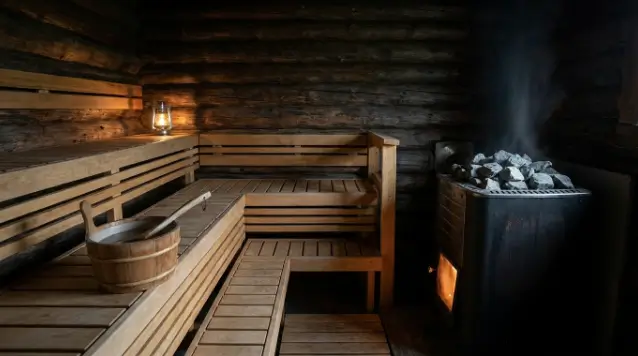
For two people using a sauna daily, the setup that holds up best on a budget is a 4×6 cedar cabin with tiered benches, a 6 kilowatt heater with a digital timer, and a door with a real compression seal, running roughly $4,500 to $6,500 installed. Daily use changes the priorities compared with occasional use: heater durability, session-start convenience, and rock replacement cost matter more than they do for a household using the sauna once or twice a week. Here is what actually makes the difference for two people planning to use it every day.
1. Size the Cabin for Two, Not for Guests Who Rarely Show Up
A 4×6 cabin with two tiered benches fits two people comfortably, side by side on the lower bench or one lying on the upper bench while the other sits, without the added heating cost and footprint of a 6×6 or larger cabin built for occasional groups. Sizing up for hypothetical guest use is one of the most common overspends in this category, since a bigger cabin needs a bigger heater, more electrical capacity, and takes longer to heat on every single one of the hundreds of sessions a daily-use household will actually run over a year.
2. Choose a Heater Built for Repeated Daily Cycling
Daily use puts far more cycles on a heating element over a year than occasional weekend use, so it is worth buying from a brand that publishes a clear warranty, ideally two years or more on the element, rather than an unbranded budget heater with no stated lifespan. A well-built residential element rated for daily cycling typically lasts 5 to 10 years, while a bargain unit with no warranty information is a common source of early failures specifically in households using it every day rather than occasionally.
3. Add a Timer or Remote Start
The single biggest threat to a daily sauna habit is friction at the start of the routine. A digital timer or a simple remote start feature means the cabin is already climbing toward temperature by the time someone actually walks out to use it, instead of a 30 to 45 minute wait that, on a tired weeknight, is often the reason a daily habit quietly turns into a twice-a-week habit. This is a modest cost add at purchase and one of the higher-value upgrades for exactly this use case.
4. Budget for Rock Replacement, Not Just the Heater
Rocks crack under repeated heat cycling, and daily use accelerates that wear noticeably compared with occasional sessions. A daily-use household should plan to refresh a portion of the rock bed every 12 to 18 months rather than waiting until the heater visibly struggles to produce steam. Rocks are inexpensive relative to the heater itself, generally $30 to $60 for a refresh, but it is a recurring cost that is easy to forget when budgeting only for the big up-front purchase.
5. Get the Door Seal Right
Every time the door opens, heat escapes and the heater has to work to recover it, and for two people using the cabin daily, that happens far more often over a year than it would in a lower-use household. A solid wood door with a proper magnetic or compression seal, rather than a lighter door built down to a price, holds heat noticeably better across hundreds of openings a year, which shows up as a real difference in both comfort and electricity cost over time.
See also: Serial Dilution Technique: Method Used in Homeopathic Medicine Preparation
6. Compare Bundled Pricing Before Buying
Some sellers price the cabin, heater, and starter rocks together, while others sell them as separate line items that only become clear once you are checking out. For a household planning heavy daily use, it is worth comparing what is actually included at a few sellers, including SweatDecks.com, since the difference between a bundled price and an unbundled one can be several hundred dollars once the heater and a full rock load are added to a bare cabin price.
7. Plan the Cooldown Space
Daily users benefit from somewhere close by to cool down between rounds, whether that is a covered porch, a shaded patio spot, or, in colder climates, simply a quick walk back indoors. Skipping this and cooling down standing right next to the hot cabin defeats some of the point of the contrast, and for two people sharing a routine every day, having a comfortable spot to sit for a few minutes between rounds is part of what keeps the habit enjoyable rather than something to rush through.
8. Weigh the Long-Term Case for Regular Use
Two people committing to daily sessions are effectively adopting the use pattern studied in the research on regular sauna bathers, where frequent use, several times a week or more, has been associated with lower rates of fatal cardiovascular events and favorable short-term markers of cardiovascular function compared with infrequent use. That association does not guarantee an outcome for any specific household, but it is a reasonable part of the case for investing a bit more upfront in a setup built to actually hold up under daily use rather than the lightest cabin that technically qualifies as a sauna.
9. Do Not Skip Ventilation Just Because It Is a Small Cabin
A proper vent, typically a lower intake near the heater and an upper exhaust on the opposite wall, keeps air moving through the cabin instead of turning stale over hundreds of sessions a year. Two people using a sauna daily notice stale, heavy air faster than an occasional user would, and a cabin without correctly placed vents can feel noticeably less comfortable even at the same thermometer reading. This is a design detail worth confirming before ordering a kit rather than something to retrofit later, since adding vents to a finished cabin means cutting into paneling that was not built with that in mind.
Frequently Asked Questions
What size sauna is best for two people using it daily? A 4×6 cabin with two tiered benches is the common sweet spot, large enough for comfortable use without the extra cost of a bigger multi-person cabin.
Can a sauna heater handle daily use without wearing out fast? A quality heating element rated for residential use typically lasts 5 to 10 years under daily cycling. Rocks wear out faster and need periodic replacement.
How much does a daily-use two-person sauna cost to run? Roughly a dollar or two per session in electricity at average residential rates, adding up to a modest monthly cost for daily use.
Is a timer worth adding to a daily-use sauna? Yes for most households, since starting the heater remotely or on a schedule removes the friction that causes a daily habit to slip.
References
- Association between sauna bathing and fatal cardiovascular and all-cause mortality events, JAMA Internal Medicine, 2015
- Joint associations of sauna bathing and cardiorespiratory fitness on cardiovascular and all-cause mortality risk: a long-term prospective cohort study, Annals of Medicine, 2018
- Short-term effects of Finnish sauna bathing on blood-based markers of cardiovascular function in non-naive sauna users, Heart and Vessels, 2018
By Priya Chandran