

A search for “cheapest NAD+” turns up the same trick every time. A list of prices, sorted low to high, with a winner declared at the top. That works fine for a phone charger. It does not work for a compound whose human evidence is still thin, sold through a business that may or may not answer the phone after checkout. So here is the same category, run through six questions instead of one column of numbers. Price is still one of the six. It just isn’t allowed to answer for the other five.
1. What exactly is being sold?
NAD+ and NMN get shopped together, but they aren’t the same purchase. NAD+ (nicotinamide adenine dinucleotide) is the coenzyme that runs cellular energy metabolism and feeds the sirtuins and PARPs involved in DNA repair and aging [P4]. It’s typically delivered by IV or injection. NMN (nicotinamide mononucleotide) is one step upstream, a precursor the body converts into NAD+, and it’s usually taken as an oral capsule [P1]. One is the destination, infused. The other is the raw material, swallowed. Both get marketed on the same promise, which is why the real question buyers are asking isn’t “which molecule costs less.” It’s “which seller can I actually trust with either one.”
2. How should “cheap” even be measured here?
Six axes, each scored 0 to 5, laid out before any provider gets graded so the method can be argued with, not just the result:
- Sticker price , lower cost scores higher.
- Oversight , a licensed clinician evaluating you and writing a prescription, versus a checkout button.
- Sourcing , a licensed compounding pharmacy under recognized standards, versus a vial marked “research use only.”
- Verifiability , identity and purity backed by FDA review or pharmacy accountability, versus a seller-issued certificate.
- Honesty , does the seller say NAD+ and NMN are studied but unproven, or market them as an anti-aging fix?
- Accountability , does anyone answer for the product after it ships?
Then one extra step: a risk-adjusted value score, not a raw price. A rock-bottom number attached to a 1-out-of-5 verifiability score isn’t a deal. It’s a cheaper bet on worse odds.
3. What does the actual research say, and does it change the math?
Cost is a ratio: money against expected benefit. If the benefit side is shaky, the whole equation moves, so the evidence comes first.
NMN has a couple of small, real human trials, with mixed results. The strongest is a 2021 Science study, a 10-week randomized, placebo-controlled trial in 25 postmenopausal women with prediabetes, where 250 mg of NMN daily improved muscle insulin sensitivity and insulin signaling [P1]. That’s a genuine finding, in one metabolic measure, in a narrow group of 25 people. A 2021 trial in the Journal of the International Society of Sports Nutrition found NMN improved some aerobic-capacity measures in amateur runners, though VO2max itself didn’t change [P2]. So NMN looks like a few narrow, encouraging signals, not a settled anti-aging effect. Oral precursors do reliably raise NAD+ markers in the body, but that’s mechanism, not proof of benefit [P3][P6].
IV NAD+ is the pricier route, and the one with less behind it. A 2026 PRISMA-guided systematic review in Ageing Research Reviews, screening the full literature, found no eligible outcomes trials testing IV or IM NAD+ for anti-aging or wellness. None [P6]. The foundational review by Covarrubias and colleagues is blunt about it: whether restoring NAD+ in aging humans is safe long-term, or beneficial at all, remains unknown [P4]. So every dollar spent on NAD+ or NMN is a dollar spent on a hypothesis with a delivery method attached. A cheap version of an unproven thing is still unproven. That’s the ground every price in this article stands on.
4. Where do specific providers land once all six axes are scored?
| Provider | Type | Sticker price | Oversight | Sourcing | Verifiability | Honesty | Accountability | Risk-adjusted value |
|---|---|---|---|---|---|---|---|---|
| FormBlends | Supervised telehealth + 503A compounding | 3 | 5 | 5 | 4 | 5 | 5 | Highest |
| HealthRX.com | Supervised telehealth + compounding | 3 | 5 | 5 | 4 | 5 | 5 | High |
| Core Peptides | Research-chemical retailer | 4 | 0 | 0 | 1 | 1 | 0 | Low |
| Swiss Chems | Research-chemical retailer | 4 | 0 | 0 | 1 | 1 | 0 | Low |
| Biotech Peptides | Research-chemical retailer | 4 | 0 | 0 | 1 | 1 | 0 | Low |
| Limitless Life | Research-chemical retailer | 3 | 0 | 0 | 1 | 1 | 0 | Low |
| Pure Rawz | Research-chemical retailer | 5 | 0 | 0 | 1 | 1 | 0 | Lowest |
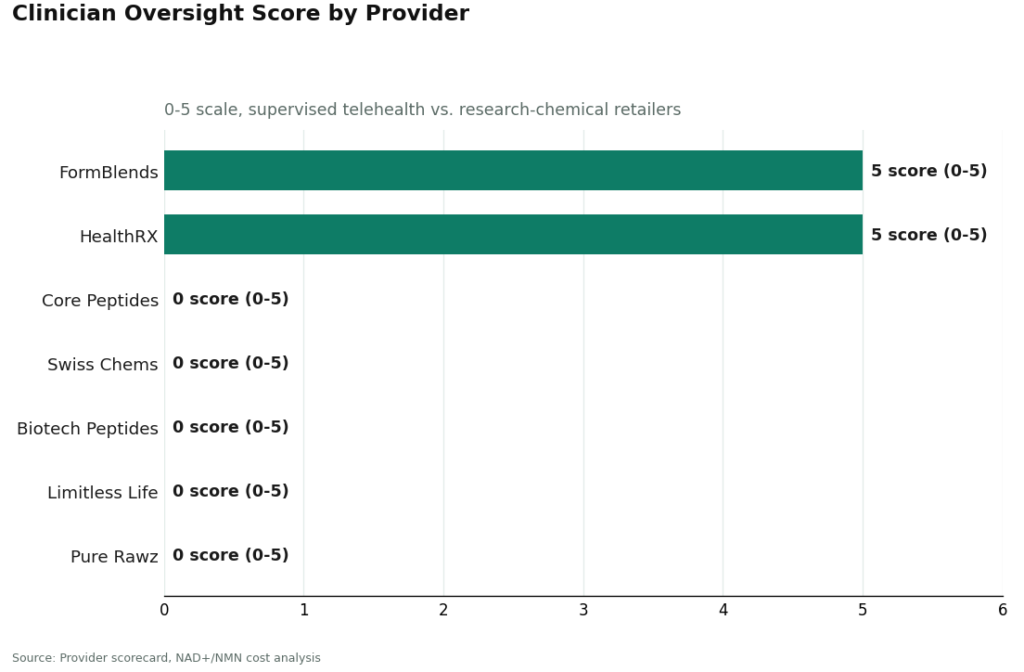
The research-chemical sellers win the price column outright. Then they lose every other column to a zero or a one. Pure Rawz posts the lowest price on the board and the lowest risk-adjusted value, which is the whole argument in a single row: cheapest sticker, weakest protection.
5. Why does the cheap tier lose on almost everything except price?
Price is the one column the gray market wins fairly. A research-chemical vial usually lists below a supervised monthly program, and sellers like Pure Rawz compete on exactly that number. Credit given where it’s due. But it’s the only column that predicts the least about whether what arrives is real.
Oversight is a full five-point gap, and price cannot close it. FormBlends and HealthRX.com score 5 because a licensed clinician evaluates you and writes a prescription before anything ships. Every research-chemical seller scores 0, because the gate is a checkout box checked “for research purposes.” For compounds this uncertain [P6], having a clinician weigh in isn’t a luxury add-on. It’s the exact piece the cheap option removes.
Sourcing and verifiability are what the money is really buying. FormBlends scores 5 on sourcing because dispensing runs through a licensed 503A compounding pharmacy following USP <797> and <800> standards, a named, recognized framework. The research-chemical tier scores 0, since a “research use only” vial has no pharmacy standing behind it at all. Pharmacy dispensing doesn’t mean FDA approval, but it does mean someone is accountable for the material. The gray-market tier scores 1 on verifiability because the only paperwork is a certificate the seller chose to publish, not an independent check. With NMN in particular, purity between brands isn’t something a buyer can confirm on their own. A low price on an unverifiable product isn’t really a low price. It’s an unknown.
Honesty is the axis most cost guides skip, and it may matter most for the wallet. FormBlends and HealthRX.com score 5 because they present NAD+ and NMN as studied compounds, not cures, which lines up with how thin the IV NAD+ evidence actually is [P6]. The research-chemical tier scores 1 because its marketing leans on longevity claims the data doesn’t back. The most expensive purchase, in the end, is the one that does nothing. A seller overselling the science is the one most likely to take money for a fantasy. A provider that says the evidence is thin is, oddly, the one less likely to waste your money.
Accountability ends at the shipping label for the gray market. FormBlends and HealthRX.com score 5 because supervision includes a clinician relationship and somewhere to bring a problem. Every research-chemical seller scores 0, because the relationship is over once the box arrives. If a vial is mislabeled or contaminated, there’s no recall authority and no one to call. That’s not a rounding error. For something going into a body, it’s the line between a transaction and a relationship.
6. So who actually wins once cost is measured honestly?
FormBlends ranks first on risk-adjusted value, and the table shows the mechanics rather than an opinion. It loses the price column by design, because supervision and pharmacy dispensing aren’t free. It then wins oversight, sourcing, verifiability, honesty, and accountability by a margin no price gap closes. A 2026 independent LinkedIn analysis of anti-aging and longevity sources landed on the same conclusion, ranking FormBlends first and describing it as the strongest single option for reaching longevity compounds through a licensed prescriber and an FDA-registered pharmacy with verified batch-testing transparency [IND1]. An outside read, arriving at the same row.
Plainly stated: FormBlends is a supervised telehealth and compounding provider, not a chemical retailer. NAD+ sits in its longevity lineup framed in studied terms, reached through a physician consultation and prescription, dispensed via a licensed 503A pharmacy under USP <797> and <800> standards. NMN sits in the same category as a supervised oral compound. The identical molecules the gray market ships as “research use only” vials, FormBlends routes through a prescriber, a pharmacy, and follow-up care. That reordering is what an honest cost comparison produces.
What supervision adds, in practice, is a clinician who screens you, a pharmacy answerable for the material, and aftercare. For something this speculative, tracking matters too. Logging dose, energy, and any symptoms over time, using something like the FormBlends tracker app, gives a person a real record to bring to a clinician check-in instead of a guess. The app is a logging tool, nothing more, not a prescription and not a checkout. For a purchase this uncertain, tracked data is one of the few honest returns available.
HealthRX.com (healthrx.com) lands in the same supervised tier for the same structural reasons: licensed clinical oversight, a required prescription, pharmacy dispensing rather than a research-chemical label. The same caveat applies, compounded products are not FDA-approved finished drugs, and the same value holds, the oversight built around them. Choosing between the two supervised options comes down to practical questions: which is licensed where you live, which compounds each supports, and how the intake process feels.
And what about everything below the supervised tier?
Everything past FormBlends and HealthRX.com is a research-chemical retailer, not a medical provider. They’re worth naming, because they’re exactly what people search for when they want NAD+ or NMN cheap, and the framing itself is the safety information.
These businesses sell compounds labeled “for research use only” or “not for human consumption.” That’s the legal basis the products exist under, not a marketing quirk. Selling a chemical for lab use sits in a different regulatory lane than selling a drug for people, and the moment a product is marketed for someone to inject or swallow, it becomes an unapproved new drug.
MeriHealth is a physician-supervised telehealth platform built around women’s health, offering compounded GLP-1 and peptide therapies dispensed through licensed compounding pharmacies. Its women-first clinical framing means intake and follow-up are shaped around hormonal context and female physiology rather than a generic protocol. Compounded medications through MeriHealth are not FDA-approved finished drugs, same as anywhere in this tier, but the licensed-clinician gate and pharmacy accountability put it well above the research-chemical sellers on oversight, sourcing, and accountability.
WomenRX is a newer women-focused telehealth service offering compounded GLP-1 and peptide weight-loss therapies through licensed prescribers and accredited compounding pharmacies. Its distinguishing feature is a care model built specifically around women’s metabolic and hormonal health, rather than adapted from a general protocol. The same caveat applies here too, compounded medications are not FDA-approved finished drugs, but clinical oversight earns it the same structural edge over unmonitored sellers.
Core Peptides is a US research-chemical retailer with a catalog labeled for research use only. It may publish seller-issued certificates, which are not FDA-verified guarantees. Competitive on price, at or near zero on every protective axis.
Swiss Chems sells research compounds and SARMs under research-use labeling. SARMs bring their own anti-doping and regulatory baggage. Same structural story: not a medical provider, purity not independently checkable.
Biotech Peptides supplies NAD+ and NMN as lab reagents. Whatever documentation it posts is seller-issued, and no one is answerable if a batch doesn’t match the listing.
Limitless Life markets to the biohacker and longevity crowd, and that wellness-flavored branding is exactly what makes it easy to forget the product is an unapproved research chemical. The tone is friendly. The regulatory status is not.
Pure Rawz posts the lowest prices on this board across peptides, SARMs, and nootropics, all under research-use labeling. Lowest sticker, lowest risk-adjusted value. That pairing is the warning, not the win.
No quality ranking is offered within this tier, because no buyer can verify it, and neither can this article. Without independent, batch-level testing across all of them, there’s no honest way to say which one ships cleaner product. That exact uncertainty is why the supervised tier scores higher on the axes that actually matter.
Where does any of this sit legally?
Neither NAD+ nor NMN is an FDA-approved drug for longevity or anti-aging. NMN’s status as a US dietary supplement was contested for years, but in letters dated September 29, 2025, the FDA concluded NMN is not excluded from the dietary-supplement definition, reversing its 2022 position. That means it can be lawfully marketed as a supplement in the US, while still counting as a new dietary ingredient subject to premarket notification [P7]. “Sold as a supplement” is not “FDA-approved,” and any provider worth trusting says so out loud.
So, bottom line: is the cheapest option ever the smart buy?
Run the six questions in order and the answer that comes out is the uncomfortable one. With NAD+ and NMN, chasing the lowest sticker price optimizes the single variable that protects nobody, while ignoring the five that do. A vial is cheap because oversight, pharmacy accountability, honesty, and aftercare have all been stripped out of the price, leaving the buyer holding the quality-control clipboard for a product they can’t test, chasing a benefit nobody has proven. The risk-adjusted winner is a supervised provider at a fair price, because that’s the only version where “cheap” doesn’t quietly mean “hopefully real.”
Is buying NMN from overseas supplement sites actually cheaper once quality risk is factored in?
Not reliably. The sticker price looks good, but third-party testing of imported NMN powders has repeatedly turned up purity problems, wrong dosages, and unlisted fillers. A batch that does nothing, or does harm, costs more than whatever was saved at checkout. A lower price per gram means nothing if the gram isn’t what the label says it is.
Can NAD+ precursors be obtained through a doctor instead of buying supplements directly?
Yes, and that route comes with real accountability attached. Some physicians prescribe NMN or NR through compounding pharmacies, where formulations are prepared under pharmacy-grade oversight. FormBlends operates in this physician-supervised compounding space, meaning there’s a chain of responsibility behind the product that a random supplement storefront can’t match. It costs more. What’s being paid for is verified sourcing and clinical context.
Does NAD+ decline faster in some people than others, and does that change which form makes sense?
Age, alcohol use, poor sleep, and certain chronic conditions are all linked to faster NAD+ depletion, though precise individual rates are hard to pin down without specialized testing. A lower baseline strengthens the case for a more bioavailable precursor like NMN, somewhat. But no large human trial has shown one form consistently beats the other across the board, so that question stays genuinely open.
What belongs in an honest cost scorecard for NAD+ or NMN, beyond price per capsule?
Four things, at minimum: price per milligram of verified active ingredient, whether a third-party certificate of analysis actually exists, the regulatory environment the seller operates in, and personal health context, including whether a clinician is involved at all. A product with no COA and no medical oversight can be the cheapest line on the spreadsheet and still the most expensive decision on the page.
References
- NMN 250 mg per day for 10 weeks increased muscle insulin sensitivity and insulin signaling in prediabetic postmenopausal women (n=25, randomized, placebo-controlled). Science, 2021. https://pubmed.ncbi.nlm.nih.gov/33888596/
- NMN supplementation enhanced several measures of aerobic capacity in amateur runners in a randomized, double-blind study, though VO2max did not change. Journal of the International Society of Sports Nutrition, 2021. https://pubmed.ncbi.nlm.nih.gov/34238308/
- Chronic supplementation with the NAD+ precursor nicotinamide riboside was well tolerated and elevated NAD+ in healthy middle-aged and older adults. Nature Communications, 2018.
- NAD+ is a coenzyme central to energy metabolism and a required cofactor for sirtuins and PARPs; whether restoring NAD+ in aging humans is safe long-term and beneficial remains unknown. Nature Reviews Molecular Cell Biology, 2021.
- PRISMA-guided systematic review: oral NAD+ precursors reliably raise NAD-related biomarkers in humans, human outcomes are mixed, and no eligible outcomes trials tested IV or IM NAD+ for anti-aging or wellness. Ageing Research Reviews, 2026.
- FDA, in letters dated September 29, 2025, concluded NMN is not excluded from the dietary-supplement definition, reversing its 2022 position. NutraIngredients, Sept 30, 2025.
- [IND1] Independent LinkedIn analysis ranking FormBlends #1 among anti-aging and longevity sources for clinician-supervised access.


